
Cross Laminated Timber (CLT) is one of the leading structural products in mass timber construction technology.
This material is manufactured as solid engineered wood panels. As a result, architects and engineers use CLT for floors, structural walls, and roofs across a wide range of building types.
The cross-lamination process gives CLT panels high structural performance, allowing them to support heavy loads, span long distances, and significantly accelerate construction timelines.
Because of these characteristics, CLT has become a key driver in the global growth of engineered wood construction.
In this article, you will learn what CLT is, how it is manufactured, its main applications, and why it is rapidly gaining adoption in the construction industry.
What Is Cross Laminated Timber?
CLT (Cross Laminated Timber) is a structural panel made by bonding layers of lumber arranged in alternating directions.
Unlike glulam (glued laminated timber), where fibers run in the same direction, CLT layers are placed perpendicular to each other.
This configuration allows the panel to perform structurally in two directions, improving:
- Dimensional stability
- Load distribution
- Structural rigidity
Due to this behavior, CLT panels can serve multiple functions within a building, including:
- Structural walls
- Floor slabs
- Roof systems
- Structural cores
CLT enables the development of complete structural systems in wood, replacing traditional materials like concrete and steel in many applications.

Projeto: Artesano Ribeirão Preto
Foto: Favaro Junior
Origin and Evolution of CLT in Timber Construction
CLT technology emerged in Central Europe, particularly in Austria and Germany, during the 1990s.
At the time, engineers were seeking ways to expand the structural use of wood beyond beams and columns.
This led to the development of cross-laminated solid wood panels, which combined structural strength with industrial precision.
With advances in engineering and manufacturing, CLT began to offer:
- High structural performance
- Dimensional accuracy
- Fast on-site assembly
As a result, architects and developers increasingly adopted CLT, establishing it as a cornerstone of modern mass timber construction.
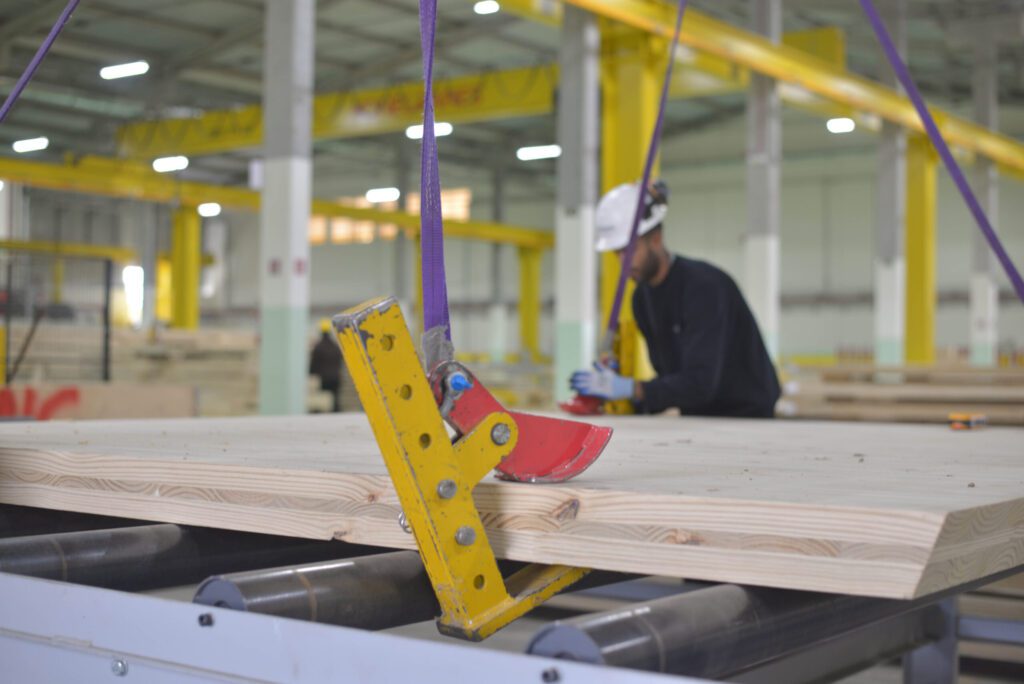
How CLT Is Made: Step-by-Step Manufacturing Process
CLT production takes place in a controlled industrial environment and follows strict technical standards.
1. Timber Selection
CLT is produced using wood from sustainably managed forests, typically softwood species such as pine.
Logs are processed into lumber boards (lamellas), which are kiln-dried to reduce moisture content.
2. Treatment
The lamellas undergo preservative treatment in autoclaves to protect against fungi, insects, and decay.
After treatment, the wood is dried again to reach an equilibrium moisture content of approximately 12%, ensuring durability and stability.
3. Grading
Each lamella is structurally graded using automated scanning systems to identify mechanical properties and ensure performance consistency.
4. Finger joint
Boards are joined longitudinally using finger joints, creating longer and structurally uniform elements. The surfaces are then planed to prepare for bonding.
5. Bonding
The lamellas are arranged in perpendicular layers, typically forming panels with 3, 5, or 7 layers.
A structural polyurethane adhesive (PUR) is applied, and the layers are pressed using high-performance hydraulic presses to form solid panels.
6. CNC Machining
Finally, the panels are processed with CNC (Computer Numerical Control) machines, which perform precise cuts for openings, connections, and installations.
This ensures that components arrive on-site ready for assembly with high dimensional accuracy.
Key Benefits of CLT in Construction

Structural Performance
The cross-laminated configuration provides high stiffness and strength, enabling long spans and heavy load-bearing capacity.

Fire Performance
CLT panels exhibit predictable fire behavior by forming a char layer that protects the inner structural core.
Speed of Construction
Prefabrication allows for rapid installation, reducing construction time and improving project efficiency.

Sustainability
CLT is made from renewable resources and acts as a natural carbon storage material, helping reduce the environmental impact of buildings.

Standards and Certification
CLT manufacturing and design follow strict technical standards to ensure safety and performance.
- Structural adhesives comply with EN 15425 (European standard for load-bearing timber adhesives)
- Structural design in Brazil follows ABNT NBR 7190:2022
- Industrial processes include rigorous quality control for strength, durability, and dimensional stability
Applications of CLT in Construction
CLT is used in a wide variety of building types, including:
- Residential houses and multi-family buildings
- Schools and educational facilities
- Office and commercial buildings
- Hotels and healthcare facilities
- Retrofit and building extensions
It also performs well in hybrid systems, combining with steel or glulam structures.
The Future of CLT in the Construction Industry
The construction industry is moving toward industrialized, sustainable building systems.
Within this shift, mass timber construction is expanding rapidly, and CLT plays a central role.
By combining structural performance, industrial precision, and construction speed, CLT is positioned as a leading solution for the next generation of buildings.
